Persistent Drive for Autonomy
Understanding PDA
About PDA
What is Persistent Drive for Autonomy?
This page brings together handouts, a webinar, and information to support a deeper understanding of PDA. These resources are grounded in lived experience, neuroaffirming practice, and a compassionate understanding of PDA as a nervous-system-based response to perceived pressure or loss of autonomy.
Persistent Drive for Autonomy (sometimes referred to as Pathological Demand Avoidance) is not a behaviour problem, a parenting issue or a lack of resilience. It is a nervous system survival response to pressure or ‘threats’ to autonomy, safety, predictability, dignity and connection.
For individuals with a PDA profile, demands and pressure are experienced at a nervous system level as threat. When threat is detected, the nervous system moves into survival states such as fight, flight, freeze, or shutdown.
Support must therefore focus on reducing threat, not increasing compliance, while always supporting nervous system regulation.
Free webinar
Understanding PDA: A 20-Minute Webinar
A clear, compassionate introduction to Persistent Drive for Autonomy and what it can look like in everyday life. Watch it right here.

Reduce threat. Restore safety. Capacity can reopen.
Understanding Fluctuating Capacity
A central feature of PDA is fluctuating capacity. Capacity is not fixed, and it cannot be accurately understood by looking only at behaviour, attendance or willingness. As pressure, demands, sensory load, social stress, unpredictability and loss of autonomy build up, the child’s window of capacity begins to close.
These changes are not regression or refusal. They are signals that the nervous system is overwhelmed and operating in survival mode. The skill is not gone - the nervous system does not currently have the safety or regulation required to access it.
Capacity can change across many areas, including:
Areas of Change in Detail
Self-Care
Difficulties with washing, dressing, brushing teeth, or tolerating everyday self-care tasks often increase when the nervous system is under sustained threat. These tasks require sequencing, motor planning, interoception and capacity for sensory input.
Toileting
Changes in toileting are a frequent signal of nervous system overload - constipation, withholding, accidents, increased frequency, recurrent UTIs or avoidance of toileting environments. Stress and threat directly affect gut motility, pelvic floor coordination and interoceptive awareness.
Safety
As capacity closes, children may become more hypervigilant or seek safety through hiding, running, bolting or staying close to trusted adults. Some children may engage in head banging, self-injury or risk-taking behaviours as attempts to regulate overwhelming internal states. These behaviours signal distress, not intent.
Feeding
When capacity is reduced, feeding can become increasingly restricted. Children may eat less, rely on a smaller range of safe foods, experience nausea or gagging or meet criteria for ARFID. Loss of appetite or increased restriction is a nervous system response, not oppositional behaviour.
Sleeping
Sleep is highly sensitive to nervous system state. Increased night waking, difficulty falling asleep, early waking, nightmares or inability to sleep alone can all emerge when the nervous system is in survival mode, narrowing capacity further.
Communication
Communication often changes significantly when capacity is low. Children may speak less, rely more on gestalts, scripting, echolalia, gesture or behaviour, or withdraw altogether. This reflects reduced access to language under threat, not unwillingness to engage.

What Opens the Window of Capacity
Capacity begins to reopen when pressure is reduced and safety is restored. Most importantly, capacity reopens when a child experiences that their communication changes outcomes and that connection remains intact even when they cannot cope.
- Identifying pressures and demands that can be reduced or removed
- Creating environments that feel predictable and emotionally safe
- Honouring autonomy and consent
- Listening to the child's communication in all its forms
- Supporting regulation through co-regulation and modelling
- Maintaining unconditional positive regard
Honouring autonomy while supporting the nervous system is not permissive. It is protective.
Free handout
Download our resources
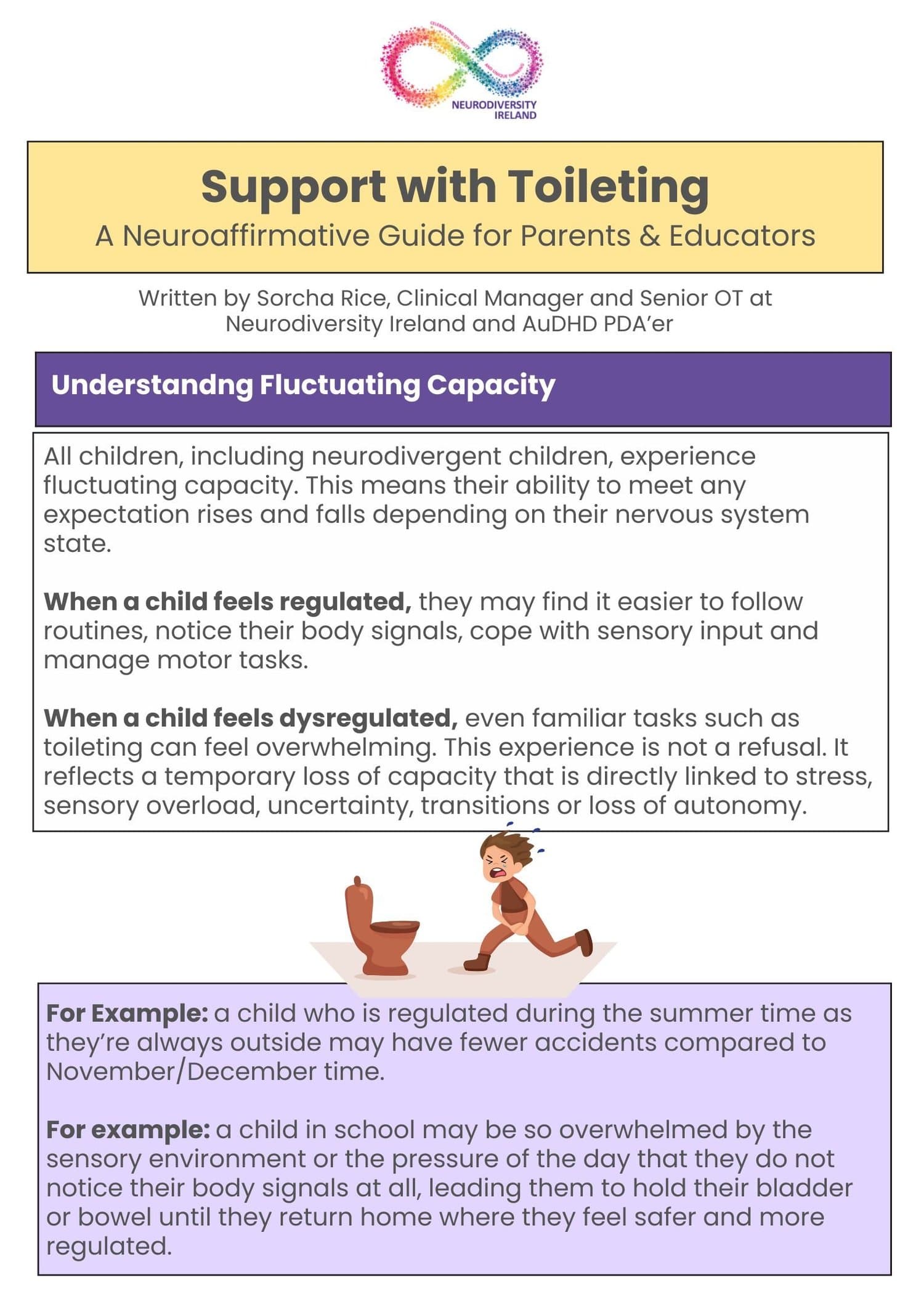
Support with Toileting
A Neuroaffirmative Guide for Parents & Educators
Written by Sorcha Rice, Senior Occupational Therapist, this guide explains toileting changes through a fluctuating-capacity lens - why they happen, what they signal, and how to respond with safety and regulation rather than pressure.
Download handout (PDF)
When safety is restored, children get to be children.
We recommend
A book for families and professionals

When the Naughty Step Makes Things Worse
Dr Naomi Fisher & Eliza Fricker
A compassionate, illustrated guide for families whose children don’t respond to traditional reward-and-consequence approaches. The authors explain why behaviourist strategies often backfire for pressure-sensitive or neurodivergent individuals, and offer a low-demand, relational alternative aimed at increasing safety, choice, and connection rather than escalating conflict.

Looking for support for a child with a PDA profile?
We are here to help, with neurodiversity-affirming, child-led practice.
Contact us